Tibial Plateau Leveling Osteotomy (TPLO) Surgery for Dogs in Prince George, BC
What is TPLO?
At CHVC, we perform TPLO surgery for dogs in Prince George who have torn CCLs.
Tibial Plateau Leveling Osteotomy (TPLO) surgery is a common orthopedic surgery for pets, mainly large dogs, who are most inclined to injure their cruciate cranial ligaments (CCL), which is the general equivalent of the ACL in a human, and found in the hind legs. TPLO negates the need for the ligament entirely, which after recovery lets them return to a fully active lifestyle.
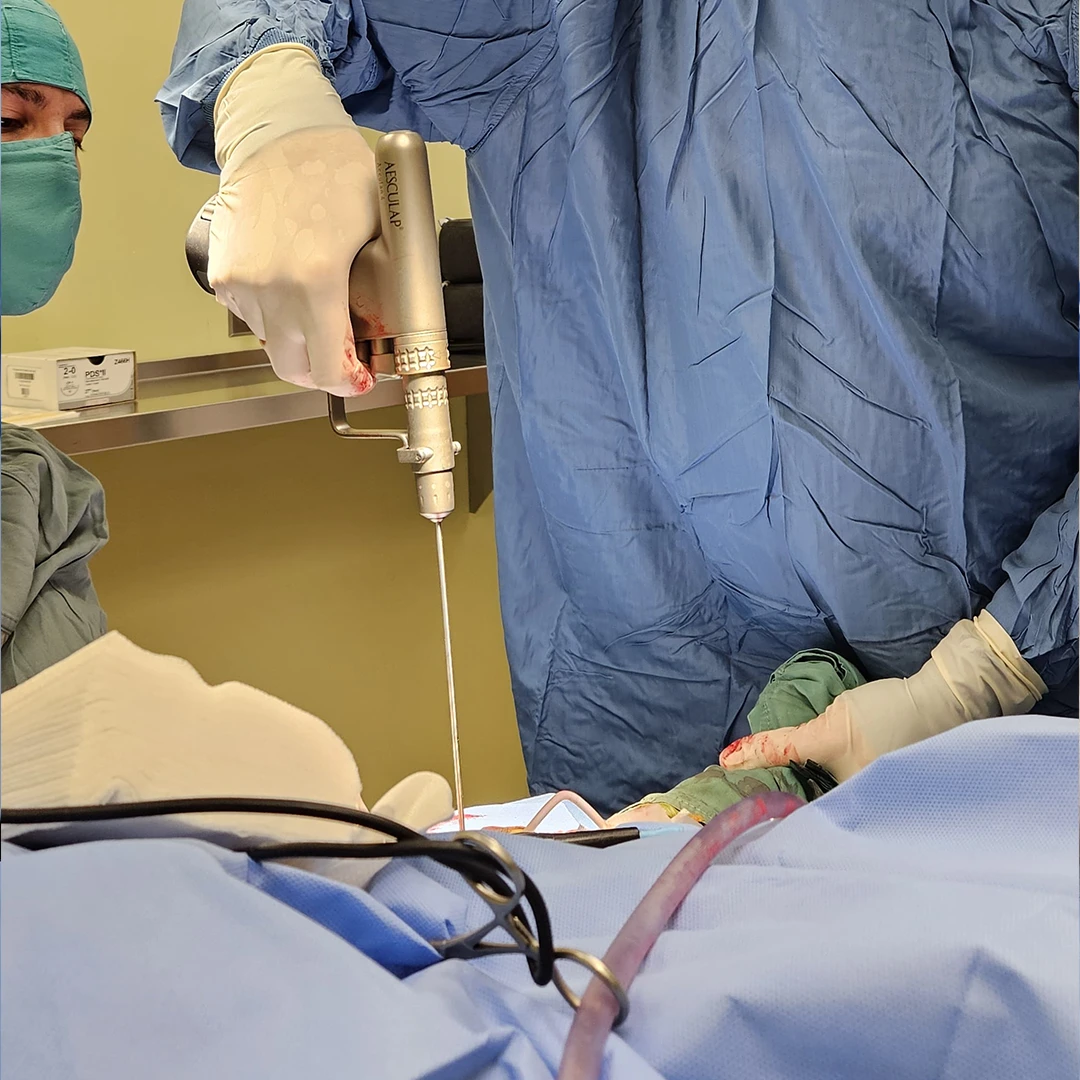
TPLO provides dynamic stabilization of the knee by reshaping the top of the tibia bone to alter the knee joint’s mechanics, stabilizing it by changing the angle so the torn ligament is no longer needed to prevent the femur from sliding off the tibia. This includes a semicircular cut in the tibia, rotating the top section to a new more level position, and securing it with a bone plate and screws.
Why We Perform TPLO Surgery
TPLO is for mainly dogs with torn CCLs.
The surgery works by negating the need for the ligament entirely, which makes it a highly effective long-term solution. The procedure has very consistent outcomes, and most dogs who receive it eventually go back to an active lifestyle after they’ve healed.
What to Expect from Your Pet’s TPLO Surgery
A quick overview of the process.
Once we’ve decided on using TPLO for your pet’s injury, we’ll bring your pet in for the surgery and put them under general anesthesia, which means they’ll need to fast for 12 hours prior to the surgery. We’ll discuss the risks with you again and have you sign off on the surgery before we begin.
After the surgery, we’ll provide you with instructions for post-operative care, provide you pain medication and a schedule to administer it on, and discuss what to watch for in term of signs of infection. Side effects include mild swelling, minor bruising, and minor clear discharge at the incision site.
You’ll need to restrict activity for the next few weeks while the bone heals. We’ll give you a schedule specific to your pet, but as a rule, over the next 4 weeks to 3 months, you can gradually include leash walks into your pet’s activity. We’ll schedule x-ray appointments to check on how the bone is healing over this period as well to give you a better idea of how much activity your pet can handle. Over the next 3 to 6 months your pet should be able to gradually return to normal activities, including running, jumping, and playing after the 6-month point.
It is important to be aware that pets with one torn CCL are at an increased risk of tearing ligament in their other leg. A healthy weight and good physical conditioning can help reduce this risk. We can discuss pet weight loss and physical conditioning with you in detail if it will help.